Hacking Power
A few years ago, in a souk in old Damascus, you could find some of the strangest lingerie on earth: thong panties made out of psychedelic flowers that blinked with multi-colored lights, bras that said “I love you” when you pushed a well-concealed button, and flimsy underwear made out of fake hands, complete with fingernails painted in bright red nail polish. Ayah Bdeir, a media artist and TED fellow, used this discovery to challenge and subvert the static representations of Muslim women found in Western media. Bdeir’s work, entitled “Teta Haniya’s secrets” reveals that images of women from the Arab world have been largely regulated and constructed by powerful media regimes.
The word “hack”, transliterated into Arabic and translated as “ikhtiraq al-nizam” means “infiltrating the system”, though “nizam” can also mean “regime” (Ash-shab yurid isqat an-nizam, “the people want to bring down the regime”, was the most popular slogan of the Arab Spring). In this sense, “hacking” in Arabic means more than simply gaining unauthorized access to computerized data; the word itself suggests proactive resistance against various forms of oppression and power.
At the same time, people from the Arab world have traditionally been characterized by the West as lacking in agency, hindered in their actions by Internet censorship, fundamentalism, and rigid, state-controlled media.
Without dismissing certain political and social realities, the region has also come to represent the possibilities that emerge when technology is appropriated and utilized by individuals living in oppressive societies, and when different regimes of power are “hacked”.
Beginning with Iran’s “Twitter Revolution” in 2009, information posted by citizens on various social media platforms, as well as amateur images of protest and violence, began challenging the professional and corporate media’s monopoly on “news”. Bystanders used inexpensive camera phone technology to capture video clips of human rights abuses that were later circulated online, sparking uprisings across the Middle East and North Africa.
Recognizing the power of citizen journalism to hurdle the limitations of corporate and government-controlled media, David Munir Nabti opened AltCity in Beirut, “a newsroom space for citizen journalists and media innovators”. The spacious office provides a solid Internet connection and electricity to individuals working on a variety of entrepreneurial, activist, and media-related projects. AltCity’s success earned Nabti an invite to Barack Obama’s Presidential Summit on Entrepreneurship.
In Lebanon, where Internet access is often hampered by poor infrastructure, relatively scarce home computer ownership, low Internet penetration rates, and expensive connectivity, AltCity has become a vital resource for individuals who benefit from access to reliable, stable technology, as well as connection with other innovators with whom they can share ideas.
But places like AltCity can do more than challenge the dominance of powerful regime and corporate media through providing space and training to citizen journalists. As Bilal Ghalib, an innovator in the global maker movement said, “hackerspaces give people access to tools and a local/global community through which people are enabled to invent their own future.” In this sense, by making technology and education available to citizens who would otherwise be deprived of access, the hacker and maker movement bring knowledge and equipment typically reserved for elites to everyday citizens.
Ghalib, along with the Global Entrepreneurship and Maker Space Initiative (GEMSI), is working to create a hackerspace in Baghdad, and has launched a Kickstarter campaign to get the plan off the ground. Less than a year ago, the same organization began a similar Kickstarter campaign to fund the opening of a temporary hackerspace in Cairo, and today, there are five hackerspaces across Egypt. Just a year and a half after the collapse of Mubarak’s regime, these hackerspaces are aiding individuals in creating solutions to problems within their own communities that they’ve identified for themselves.
In addition to providing space around which to organize and share ideas, the maker movement has granted young people access to elite technologies like 3D printers and laser cutters, along with open-source electronics.
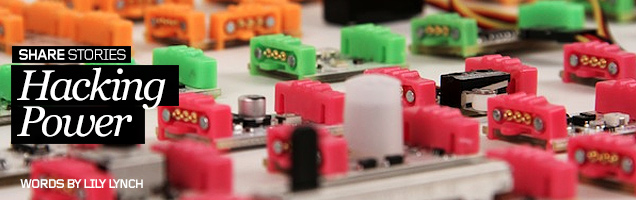
Recognizing the importance of making technology more accessible, Bdeir invented littleBits, a kind of “next level” Lego set for the digital age. littleBits, which have recently been featured on CNN and at a TED talk in California, contains pre-integrated circuitry with magnetized constituent parts. The little set of green, pink and orange blocks illuminate when connected and enable individuals with little expertise or education in electronics to better understand how electronics work. littleBits also allows artists and designers to easily integrate electronics into their pieces or installations. So far, littleBits users have created a garage-door opener, a coffeemaker, a pair of blinking shoes, and a joystick. As a member of the open source hardware movement, Bdeir has made instructions on how to build your own set of littleBits available online.
Bdeir is also an artist, and her work utilizes technology and media to explore fixed notions of Arab Identity. As with littleBits, her recent work “Identities in Motion” challenges elite monopolies on power and construction. As the Aberdeen Centre for Contemporary Art described it, “Identities in Motion is a series of works that looks to contemporarize images of Arab identity, reinterpreting often archaic, frozen, and homogeneous imagery. The works deal with the obsession of the media to flatten the Arab identity and reduce it to a set of cliche images and iconographies.” While littleBits challenges the notion that the power to create utilizing electronics is limited to the educated elite, “Identities in Motion” challenges the “flattened” images of Arabs produced by Western media elites: Sunnis and Shias, warlords and sheiks, belly dancers and women draped in cloth.
The proliferation of new technologies and ideas has even made its way into classic forms of media, including Arabic literature. In an article entitled “Hacking the Modern: Arabic Writing in the Digital Age”, Tarek el-Ariss, a professor of Middle Eastern Studies at the University of Texas at Austin, sums up this new influence: “Hacking characterizes the intervention of a new generation in taking control of cultural production through acts of dissimulation, negotiation, and play.”
And you may be surprised to hear that through playing with 3D printers, building new joysticks out of Lego-like microcircuits, and using media art to reconfigure stereotypes about Muslim women, individuals and communities across the Middle East and North Africa are doing just that.
David Munir Nabti, Bilal Ghalib, and Ayah Bdeir are all speakers at this year’s SHARE Conference in Beirut, which will take place October 5th through 7th.
Written by Lily Lynch